Stand Out with Teardrop Flags Printing: A Guide for Print Businesses
 Abhishek Agarwal
Blog article content
Custom flag printing for print businesses delivers profit margins of 70-80% per order, average order values between $200 and $400, and a customer base that prioritizes quality and speed over price.
For print business owners, it is one of the most profitable service lines available. Print shops running large format printing software that supports flag products are particularly well-positioned to capture this demand through their online storefront.
Flags sell on urgency and emotion. A grand opening, a sports season, a memorial, a political campaign deadline. These buyers are not comparing quotes across three vendors. They need the product done right and done on time, which creates a fundamentally different sales dynamic than commodity print work like business cards or flyers.
Trade show exhibitors are one of the clearest examples of this buying behaviour. They order flags on tight pre-event deadlines and prioritise turnaround and quality above all else. Print shops using web to print software for trade shows can capture these orders directly through their storefront without manual quoting or back-and-forth on specs.
This guide is written for print business owners who want to add flag printing as a structured, profitable service. It covers the printing method used to produce flags (dye sublimation), the fabric types and their differences, every major flag format and the sizes that sell best, file specifications to share with customers, how to set up the service operationally whether in-house or outsourced, pricing structure, online ordering setup, and marketing. Whether you are evaluating custom flag printing for print businesses for the first time or looking to systematize something you are already offering, this guide covers the full picture.
Why Flag Printing Outperforms Standard Print Jobs
The margin gap between flags and standard print products is striking. Here’s how the numbers compare:
Product | Typical Margin | Average Order Value |
|---|---|---|
Business cards | 20-35% | $40-$70 |
Flyers / brochures | 20-30% | $50-$120 |
Single-sided custom flags | 70-80% | $200-$400 |
Double-sided custom flags | 75-85% | $280-$500 |
A standard business card run nets roughly $47 after materials, time, and labor. A single custom flag order for a restaurant opening, grand launch, or sports event can net $300 or more for comparable production time. A handful of flag jobs in a week can outpace dozens of smaller commodity runs.
Why Flag Buyers Are a Different Kind of Customer
Flag customers are not shopping for the lowest price. They’re buying for a specific deadline, event, or emotional reason: a business opening, a memorial, a team’s first season. That urgency changes the entire sales conversation. Quality and reliability matter more than cost, which is exactly the kind of customer relationship that’s worth building.
Want to See How Flag Ordering Works on a Print Storefront?
DesignNBuy lets your customers configure, design, and order custom flags online. 3D preview, automated pricing, and print-ready file output included.
What Is Dye Sublimation Flag Printing?
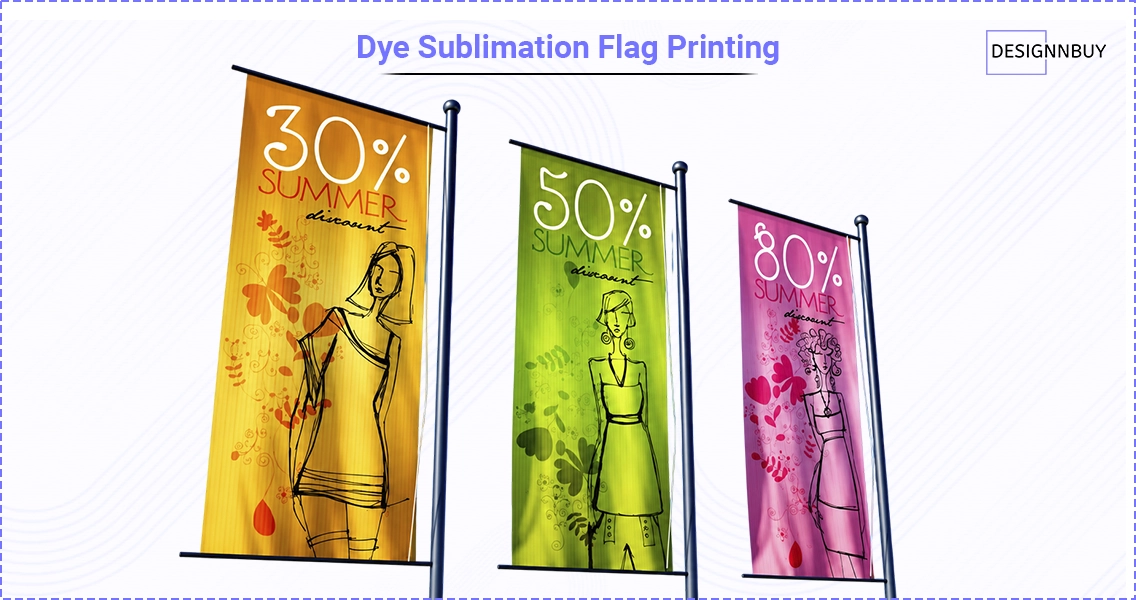 Most guides written for consumers skip this section. For print business owners, it’s foundational.
Dye sublimation is the industry-standard production method for custom flag printing. Understanding how it works informs every decision downstream: equipment, substrates, trade printer selection, file requirements, and what you can honestly promise customers.
How the Process Works
Dye sublimation uses heat and pressure to bond dye directly into polyester fabric at the molecular level, rather than depositing ink on top of the surface the way screen printing or standard digital printing does. The result:
Colors are vibrant and cannot crack, peel, or chip because there’s no ink layer sitting on top of the fabric
The fabric retains its natural texture and drape, so the flag moves and hangs correctly
On single-sided flags, the design passes through the fabric and appears as a mirror image on the reverse side (this is expected and normal)
On double-sided flags, two printed layers are bonded with a blocking liner between them so the design reads correctly from both sides
In-House vs. Outsourcing Production
Bringing dye sublimation in-house requires a large-format roll-to-roll printer, a heat calender or transfer press, RIP software, and the appropriate substrates. For most small-to-mid-size print shops, this is a significant capital commitment. You will also need a way for customers to submit or build print-ready designs in the sublimation workflow. A dedicated sublimation design software handles that layer, allowing customers to customize products online and generate files that go directly to production.
If you are evaluating heat transfer as an alternative, see how DesignNBuy’s heat transfer design software fits into that workflow.
The smarter starting point for most businesses is to outsource flag production to a trade printer and white-label the product, while retaining the design, customer relationship, pricing, and delivery on your side. This lets you launch custom flag printing for print businesses immediately, test demand, and decide on equipment investment from a position of actual volume data rather than speculation.
Both methods use heat, but they work differently and suit different products and volumes. If you’re deciding how to set up flag production, our comparison of sublimation printing vs heat transfer covers the differences in output quality, substrate requirements, and cost structure.
Read: Sublimation Printing vs Heat Transfer
Flag Fabric Types: What Print Businesses Need to Know
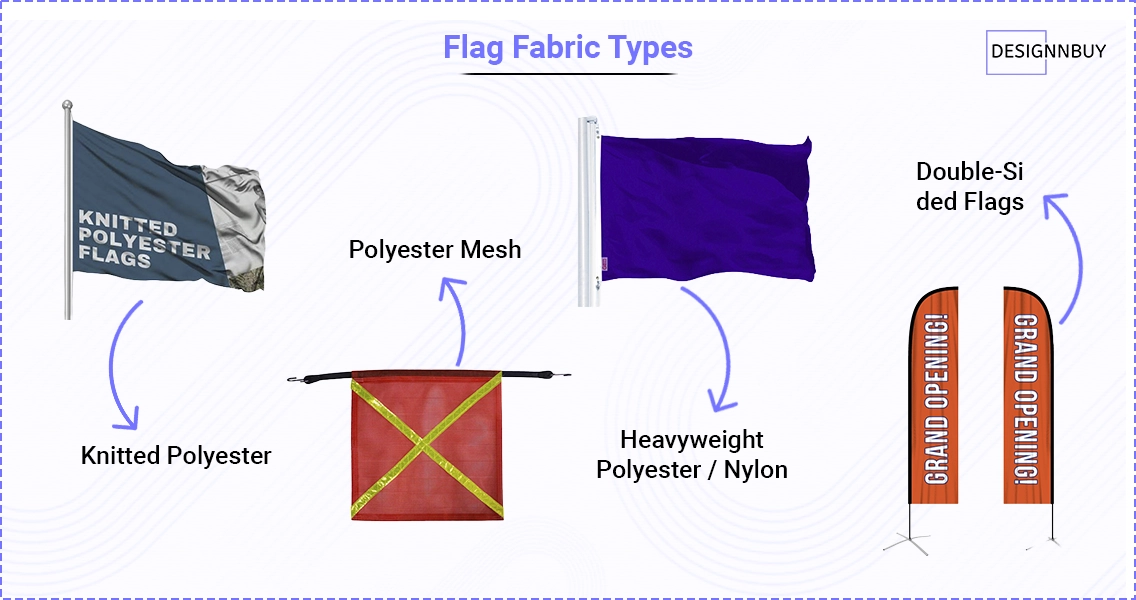 The substrate affects print quality, durability, and customer satisfaction. Knowing the options helps you advise customers, write better product listings, and build upsell logic into your pricing.
1. Knitted Polyester
The standard substrate for most custom flag printing. Lightweight, excellent dye uptake, and vivid color reproduction. Works well for indoor and general outdoor use in moderate conditions.
2. Polyester Mesh
Mesh fabric is perforated so wind passes through rather than catching. This is the correct choice for high-wind outdoor environments: roadside flags, beach events, large flagpoles. It reduces drag on hardware and significantly extends flag lifespan.
3. Heavyweight Polyester / Nylon
Used for long-term outdoor installations and traditional flagpole flags. More durable and weather-resistant than standard knitted polyester, but heavier, which requires more robust poles and mounting hardware. Nylon is particularly valued for its ability to fly well even in light wind.
4. Double-Sided Flags
Two layers of dye-sublimated fabric bonded with a light-blocking liner between them so the design reads correctly from both sides. Heavier and more expensive to produce, but a strong upsell for storefronts and trade shows where the flag will be seen from multiple directions.
Print shop tip: Price double-sided printing as a clear premium tier. It typically adds about 70% to the per-flag revenue with a proportionally smaller increase in production cost.
Flag Types Your Customers Will Order
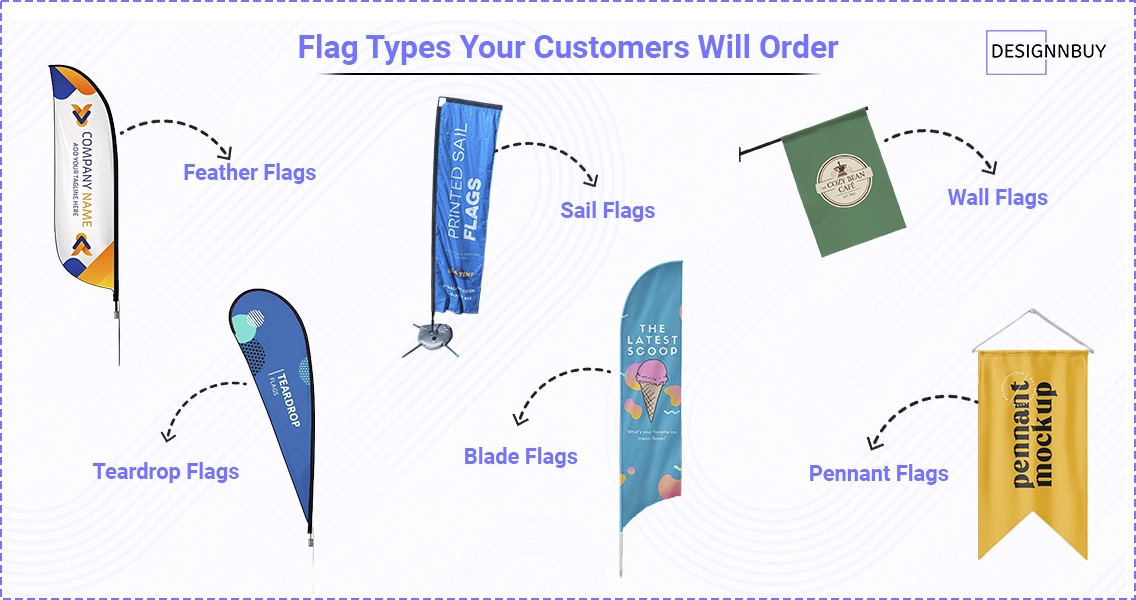 Custom flag printing for print businesses covers a wide range of flag styles. Understanding each format helps you build a complete product catalog and advise customers on the right choice for their situation.
1. Feather Flags
Tall, narrow, and constantly in motion. Feather flags are the most common format for web to print storefronts, event entrances, and promotional displays. Their movement catches attention from passing vehicles and foot traffic, but the constant flutter means designs must be simple: a bold logo or short word in the upper half, generous margins, and high contrast. Thin strokes and fine detail disappear as the fabric ripples.
Best for: Retail storefronts, grand openings, car dealerships, and event promotions.
2. Teardrop Flags
Teardrop flags hold their shape more consistently than feather flags because the curved top is attached to a rigid section of the pole. This makes them more reliable in variable or strong wind conditions. Design placement should account for the curvature: keep critical elements away from the rounded top edges.
Best for: Outdoor markets, mixed-wind environments, trade events, areas where readability needs to stay consistent.
3. Sail Flags
Wider than feather flags, sail flags offer more design real estate and a stronger brand presence. They function well as branded backdrops at trade show booths or outdoor brand activations, where you want the flag to communicate brand identity rather than just grab a glance.
Best for: Trade shows, outdoor brand displays, and larger outdoor events.
4. Blade Flags
Similar in concept to feather flags but with a more angular, blade-like profile. A stiffened top arm keeps the flag taut even in low-wind conditions. Popular in car sales environments and fast-service retail promotions.
Best for: Car dealerships, quick-service retail, promotional campaigns with high placement density.
5. Rectangle / Wall Flags
Standard rectangular flags, either mounted on a cross-arm pole or attached flat to a wall surface. They behave like traditional flags and suit clients who want a classic, institutional look: storefronts, sports facilities, schools, and organizational flags.
Best for: Storefronts, sports clubs, schools and institutions, and events with a formal flag display.
6. Pennant Flags
Triangular flags are used primarily as decorative strings or single bold-message promotions. Not suited for detailed design, but effective at creating energy and atmosphere at car lots, festivals, and seasonal retail promotions.
Best for: Car lots, festivals, holiday promotions, event decoration, and atmosphere.
Flag Sizes That Sell: A Reference Guide for Print Shops
A focused product catalog outperforms an overwhelming one. These are the sizes worth building your offering around.
Rectangle Flags
Size | Best For |
|---|---|
2×3 ft | Small storefronts, indoor display |
3×5 ft | General business use (most popular) |
4×6 ft | Larger outdoor lots, longer sightlines |
5×8 ft | High-visibility locations, large venues |
The 3×5 ft flag is the most commercially popular size for print shops. It fits standard poles without adaptation, delivers strong visibility, and sits at a price point that feels accessible to customers while maintaining excellent margins. Many successful print shops build their entire flag catalog around this as the lead product.
Feather and Teardrop Flag Heights
Height | Typical Use |
|---|---|
7-9 ft | Indoor events, tabletop or countertop bases |
10-12 ft | Standard outdoor use, storefronts, markets |
13-15 ft | High-visibility outdoor locations, large parking areas |
Pole Height to Flag Size Matching
Pole Height | Recommended Flag Size |
|---|---|
15 ft | 2.5×4 ft |
20 ft | 3×5 ft |
25 ft | 4×6 ft |
30 ft | 5×8 ft |
Advising customers on hardware sizing alongside the flag order is a natural cross-sell opportunity and helps prevent the common complaint that a flag looks small or disproportionate on its pole.
How to Add Flag Printing to Your Print Shop
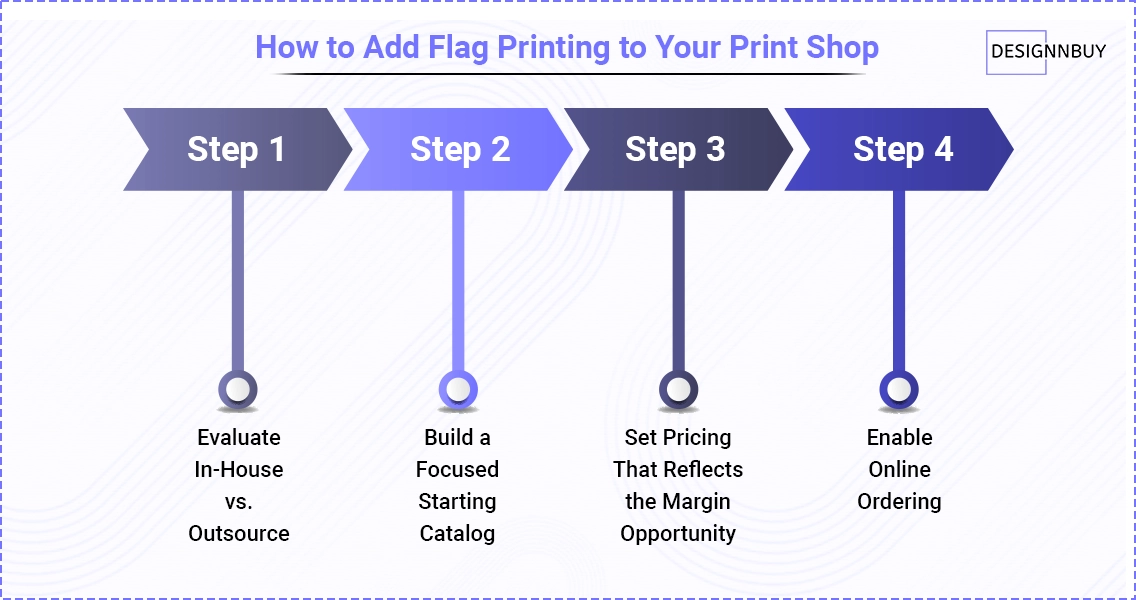 This is the section most print business owners actually need and rarely find in guides written for consumers.
Step 1: Evaluate In-House vs. Outsource
Before spending on equipment, answer two questions honestly: Do you currently receive flag inquiries that you’re turning away or referring elsewhere? And can you commit to the volume needed to justify the capital?
Dye sublimation at the scale needed for flags requires roll-to-roll equipment, a heat press or calender, and proper workflow software. This makes financial sense at sustained volumes of 50-100+ units per month for most equipment tiers. Below that threshold, outsourcing to a trade printer and white-labeling is almost always the better business decision.
Start by fulfilling your first 20-50 flag orders through a trade partner. The data you collect on types, sizes, and customer segments will be worth more than any market research when it comes time to evaluate equipment.
Step 2: Build a Focused Starting Catalog
Don’t launch with everything. A practical starting catalog for custom flag printing for print businesses:
Feather flags (2-3 heights)
Rectangle flags (3×5 ft and 4×6 ft)
Double-sided versions of each as a premium tier
Hardware bundles (pole, ground spike, carry bag) as a cross-sell
Add teardrop, sail, and blade flags once you understand which segments your customers come from.
Step 3: Set Pricing That Reflects the Margin Opportunity
Flag pricing should not be based on cost-plus alone. A 3×5 ft single-sided flag that costs $30-40 to produce through a trade printer can retail at $140-$200 with a strong margin intact. Double-sided printing adds $40-$60 at retail. Rush turnaround (48-hour) supports an additional 20-30% premium.
Build your pricing in clear tiers: standard, double-sided, and rush. Display pricing openly on your website. Flag buyers appreciate transparency, and it reduces the back-and-forth on quotes.
Step 4: Enable Online Ordering
If customers have to call or email to get a quote for a custom flag, a meaningful share of potential orders never happens. Print shops growing the fastest in custom flag printing for print businesses have an online ordering flow where customers can select their flag type, size, and material, then upload artwork directly and check out.
A web to print storefront with an integrated product design tool like DesignO and a 3D product configurator for 3D preview capability, is the single highest-leverage infrastructure investment for this service line. It captures impulse orders, reduces sales friction, and cuts down on the artwork revision cycles that eat into your margin.
Evaluating your large format software stack?
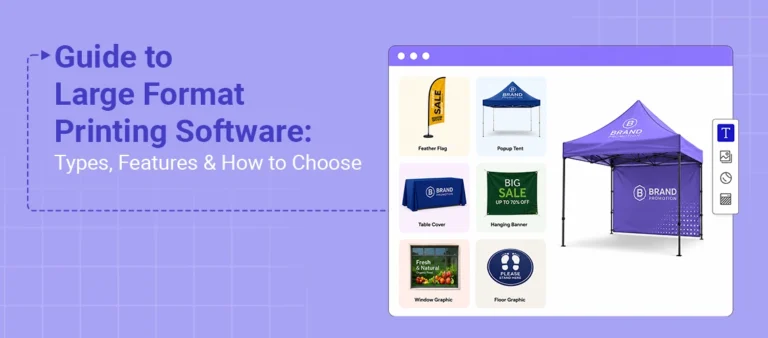
Read: Guide to Large Format Printing Software
Flag Printing File Specifications: What to Tell Your Customers
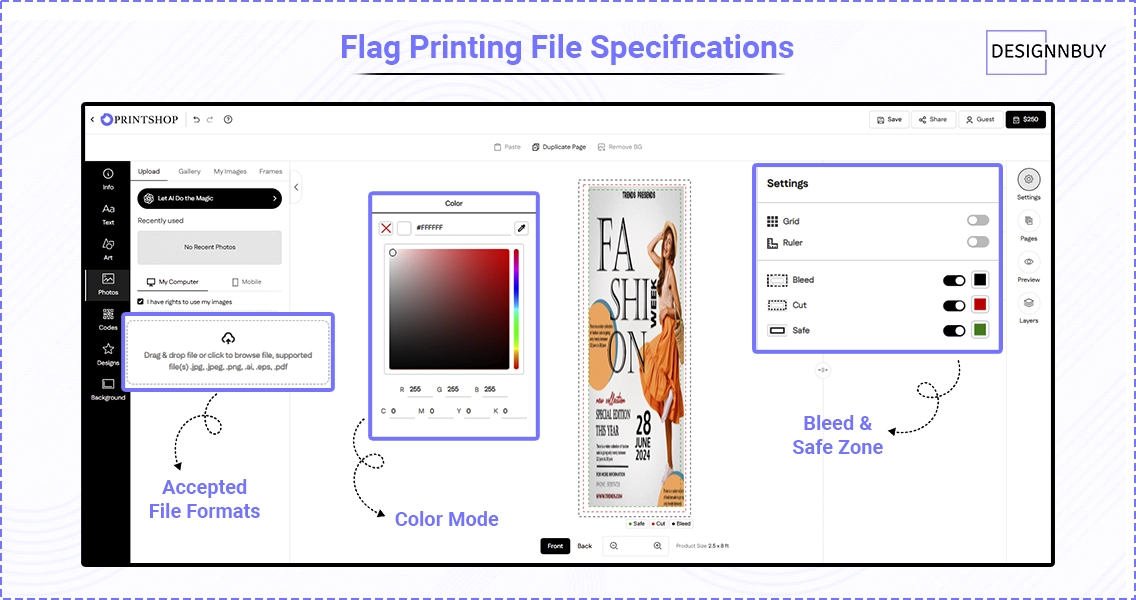 Receiving non-print-ready files is one of the biggest time costs in flag production. Clear specification guidance, published on your website and sent at the time of order, reduces revision cycles substantially.
Resolution
Minimum: 100 DPI at final print size
Recommended: 150 DPI for higher quality output
Do not upscale low-resolution images. A 72 DPI screen graphic blown up to flag size will print visibly blurry regardless of how large the file appears on screen.
Color Mode
CMYK is the standard for print production. RGB files can be accepted but require conversion, and colors may shift during that process, particularly in reds and oranges. If customers are submitting files designed on screen, this is one of the most common sources of color mismatch.
RGB files can be accepted but require conversion, and colors may shift, particularly in reds and oranges
Note any Pantone spot colors and their CMYK equivalents clearly
Bleed and Safe Zone
Bleed: 0.5 to 1 inch beyond the trim line (confirm with your specific trade printer)
Safe zone: Keep all critical content at least 0.75 to 1 inch from the edge, as hemming and finishing will consume some border area
Pole pockets, grommets, and sleeve attachments further reduce the usable area near attachment points; make sure customers are aware of this before they finalize their layout
Accepted File Formats
Format | Recommended | Notes |
|---|---|---|
AI / EPS | Best | Vector-based, infinitely scalable |
PDF (vector) | Best | Preferred by most trade printers |
PNG (high-res) | Acceptable | Must be 150 DPI+ at final print size |
PSD | Acceptable | Flatten all layers before submission |
JPG | Use with caution | Lossy compression; avoid for logos and text |
Single-Sided vs. Double-Sided File Setup
For single-sided flags, provide one design file. The design will be correct on the front and visible as a mirror image on the back (this is standard for dye sublimation through fabric). For double-sided flags, provide two separate files: a front and a back. If the design is identical on both sides, the printer will handle the flip, but confirm this with your trade partner beforehand.
Share this with your customers before they submit files.
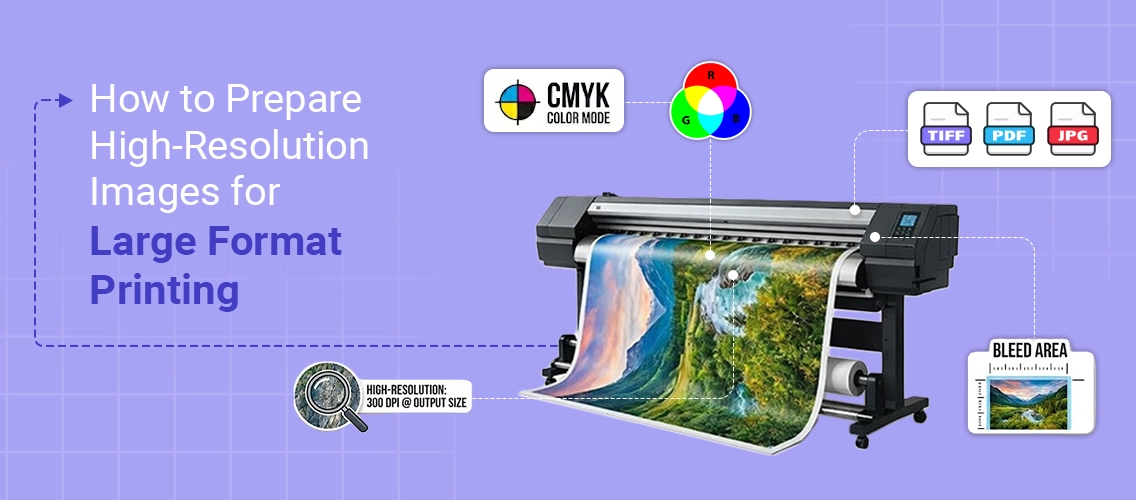
Read: How to Prepare High-Resolution Images for Large Format Printing
Profitable Flag Add-Ons and Upsells
Add-Ons That Boost Margin Per Order
Add-On | Revenue Impact |
|---|---|
Double-sided printing | ~70% more revenue per flag |
Polyester mesh fabric (high-wind) | Upsell for outdoor durability |
Rush 48-hour production | 20-30% premium on base price |
Pole and hardware bundle | Increases average order value |
Replacement flag subscription | Recurring revenue opportunity |
Upsells work best when they’re framed around the customer’s situation. A storefront client asking about a feather flag is a natural candidate for the weather-resistant mesh upsell. A client ordering for a fixed-date event is a natural candidate for rush production.
Customer Segments: Who Buys Custom Flags
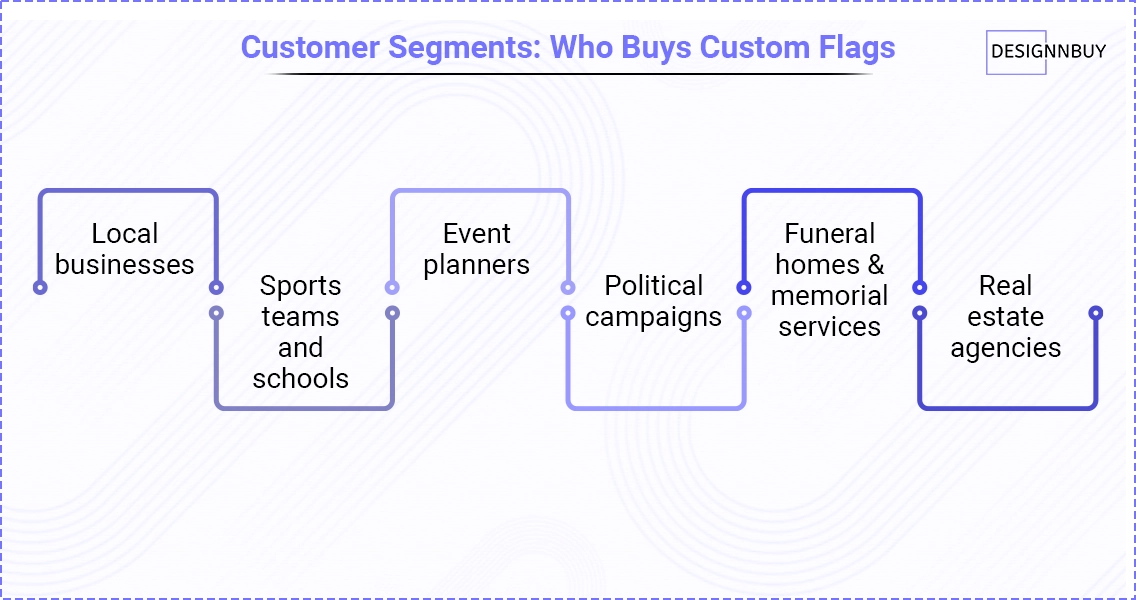 Knowing your customer segments helps you target marketing precisely and build the right referral partnerships.
Local businesses: Storefronts, restaurants, gyms, and service businesses buying for visibility. High repeat potential. Once they trust your quality, they reorder when flags wear out or seasons change.
Sports teams and schools: Seasonal bulk orders with predictable timing. Building relationships with athletic directors and booster clubs can generate consistent volume at the start of each sports season.
Event planners: One event planner relationship can mean dozens of flag orders per year across multiple clients and venues.
Political campaigns: Concentrated, time-pressured buying windows where rush capability is a meaningful competitive advantage.
Funeral homes and memorial services: Low volume, high value, emotional importance. These clients prioritize reliability and quality above all else.
Real estate agencies: Open house flags and branded property signage. Repeat and scalable.
Highest-ROI partnership targets: Event planners, school athletic programs, and funeral homes. These three segments generate consistent repeat orders without ongoing advertising spend once the relationship is established.
How to Price Custom Flag Printing
Pricing for custom flag printing for print businesses follows a straightforward structure once your cost basis is clear.
Base pricing formula: Production cost divided by (1 minus target margin)
For a 3×5 ft single-sided flag with a $35 trade production cost and a 75% target margin, your retail price should be $140. In practice, most print shops price these at $140-$180 depending on their market, which delivers strong margin and remains competitive against retail alternatives.
Build explicit tiers:
Standard: Single-sided, standard turnaround, knitted polyester
Premium: Double-sided or mesh fabric, standard turnaround
Rush: Any material, 48-hour turnaround, 25-30% surcharge
Publish your pricing. Flag buyers often decide before they contact you. Transparent pricing closes more orders than pricing-on-request.
Online Flag Ordering and Design Tools
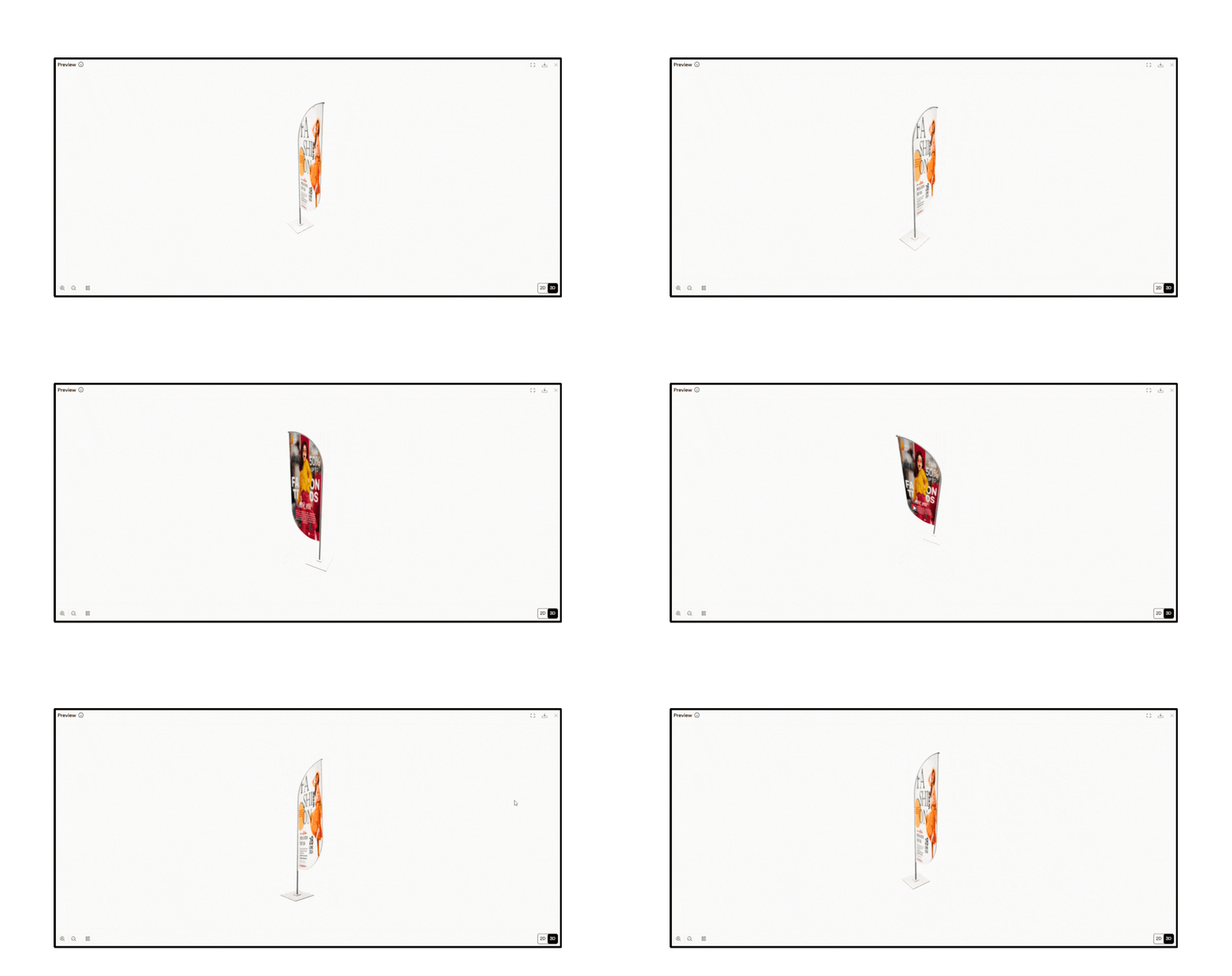 The fastest-growing segment of custom flag printing for print businesses is online ordering combined with integrated design capability.
When a customer can configure their flag, choose their size and material, upload or build their artwork, preview it in 3D, and check out without calling or emailing you, the conversion rate on interested visitors improves significantly. Print shops using online design tools with 3D preview capability report more than 50% improvement in completed online orders and substantial reductions in reprint requests, because customers verified their design before submitting.
The 3D preview matters specifically for flags because customers struggle to visualize how a logo or text will look on a large, waving, three-dimensional surface. A realistic in-browser preview reduces uncertainty, increases buyer confidence, and reduces post-order change requests.
Marketing Your Flag Printing Service
1. Local SEO
The majority of flag buyers start with a local search. Optimize your site and Google Business Profile for:
“custom flag printing [city]”
“custom flag maker near me”
“feather flag printing [city]”
“flag printing near me”
Your Google Business Profile should specifically list flag printing as a service. Include photos of completed flag work in your image gallery. Actively collect reviews from flag customers and make sure those reviews mention the product type.
2. Google Ads
High-intent buyers searching for rush or event-specific flags convert well. Effective campaigns target keywords like “custom flag printing near me,” “rush flag printing,” and “feather flag printing [city].” A focused local campaign with a $200-$500 monthly budget can realistically generate $2,000+ in orders if the targeting and landing page are set up correctly.
3. Offline Partnerships
The highest ROI marketing channel for most print shops entering flag printing is direct relationship-building:
Event planners: One relationship, recurring volume across clients and venues
Sports leagues and school athletic programs: Seasonal and predictable
Funeral homes: Repeat, low-competition, entirely relationship-dependent
Sign shops and other printers: Trade referrals for flag jobs outside their current capability
4. Content That Attracts Flag Buyers
Creating specific content around flag printing topics builds authority with AI engines for citation and captures long-tail SERP traffic:
Flag size guides by use case
Fabric comparison posts (mesh vs. polyester for outdoor flags)
How-to-design-a-flag guides for business owners
Segment-specific content: sports flags, real estate open house flags, political campaign flags
Real Profit Potential: What Custom Flag Printing Delivers Over Time
Phase | Monthly Order Volume | Estimated Monthly Profit |
|---|---|---|
Starting out (Months 1-3) | 10-15 orders | $1,000+ |
Establishing (Months 4-8) | 25-40 orders | $3,000-$5,000 |
Established (Year 2+) | 50-75 orders | $6,000-$9,000 |
These figures are based on an average order value of $250 with a 70% margin, which is achievable for a shop that has systematized production, enabled online ordering, and built a handful of high-value repeat customer relationships. A single sports league partnership or ongoing event planner relationship can compress the timeline through these phases significantly.
Conclusion: Flag Printing as a Core Revenue Line
Custom flag printing for print businesses is one of the clearest high-margin opportunities in large format printing available right now. The margin differential over commodity print work is real, the customer base is broad and repeat-friendly, and the barrier to entry through outsourced production is lower than most print shop owners assume.
The shops building the most traction in this niche have done three things: they’ve systematized production through either in-house capability or a reliable trade partner; they’ve enabled online ordering with design capability so customers can self-serve; and they’ve built a small number of high-value repeat relationships in segments like event planning, sports leagues, and local business.
Adding a flag printing service is not complicated. Getting it right operationally, priced correctly, and visible online is where the compounding returns come from.
Frequently Asked Questions
Ready to Take Flag Printing Orders Online from Your Print Storefront?
DesignNBuy gives print shops everything needed to sell, configure, and fulfill custom flag orders online, without any back-and-forth.
Abhishek Agarwal
Co-founder/CMO, DesignNBuy
Abhishek Agarwal (Co-founder/CMO, DesignNBuy) has 15+ years of IT & web-to-print experience. He specializes in sales, marketing, and strategic business growth, delivering innovative solutions to global printers and mentoring teams.
All Posts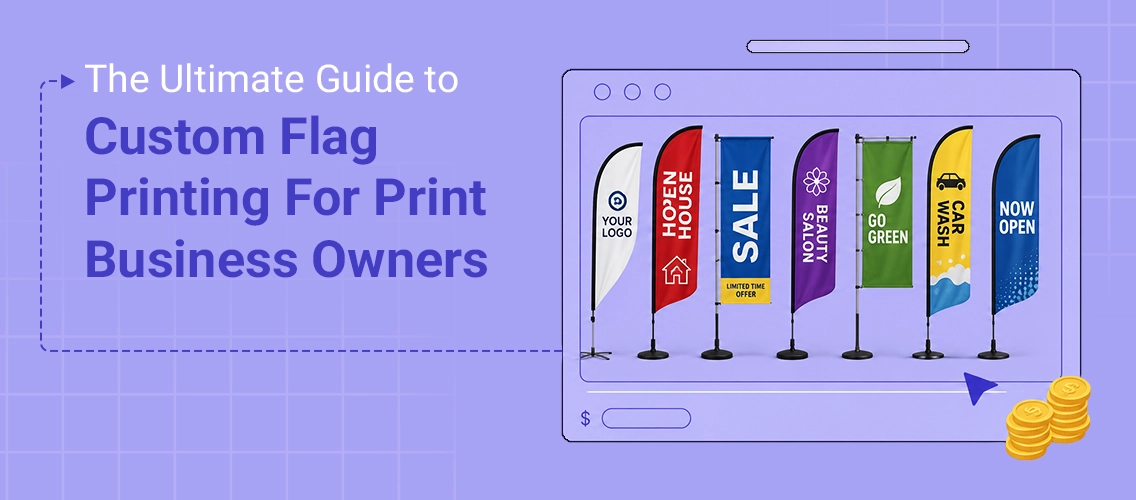
Trusted by 2000+ Print Businesses
Ready to See It in Action?
Explore our print shop platform at your convenience. Request a demo URL to experience the storefront, design tool, pricing, and much more.