The Winning Tech Stack for Print on Demand Businesses: Shopify + DesignO + Printful (2026 Guide)
In 2026, print on demand success depends on connected systems, not scattered tools. This guide explains how Shopify, DesignO, and Printful work together to support customization and scale.
 Abhishek Agarwal
Blog article content
Print on Demand (POD) is no longer an experimental business model. As we move into 2026, POD has matured into a serious, scalable eCommerce category, projected to grow into a $75+ billion global industry by 2033.
With this growth comes an important shift:
Tools no longer differentiate businesses —systems do.
After spending 15 years working with SaaS platforms, web to print platform, and eCommerce businesses across global markets, one pattern has become increasingly clear:
POD businesses that succeed at scale are built on tightly integrated technology stacks — not fragmented tools.
Among hundreds of configurations, one stack consistently stands out for stability, scalability, and long-term viability:
Shopify + DesignO + Printful. You can also explore earlier implementations in our guide to Shopify print-on-demand setup with PrintCommerce.
This is not a trend-based recommendation.
It’s an infrastructure-first approach designed for modern POD businesses that want to grow beyond side hustles into real brands.
If you’re still figuring out the overall setup, here’s a complete guide on how to start a print on demand business before choosing your tech stack.
Understanding the POD Business Model in 2026
 Print on Demand solutions fundamentally changes how commerce works.
Instead of producing inventory upfront, POD businesses:
Manufacture products only after an order is placed
Eliminate inventory holding costs
Reduce waste and unsold stock
Enable unlimited design variations
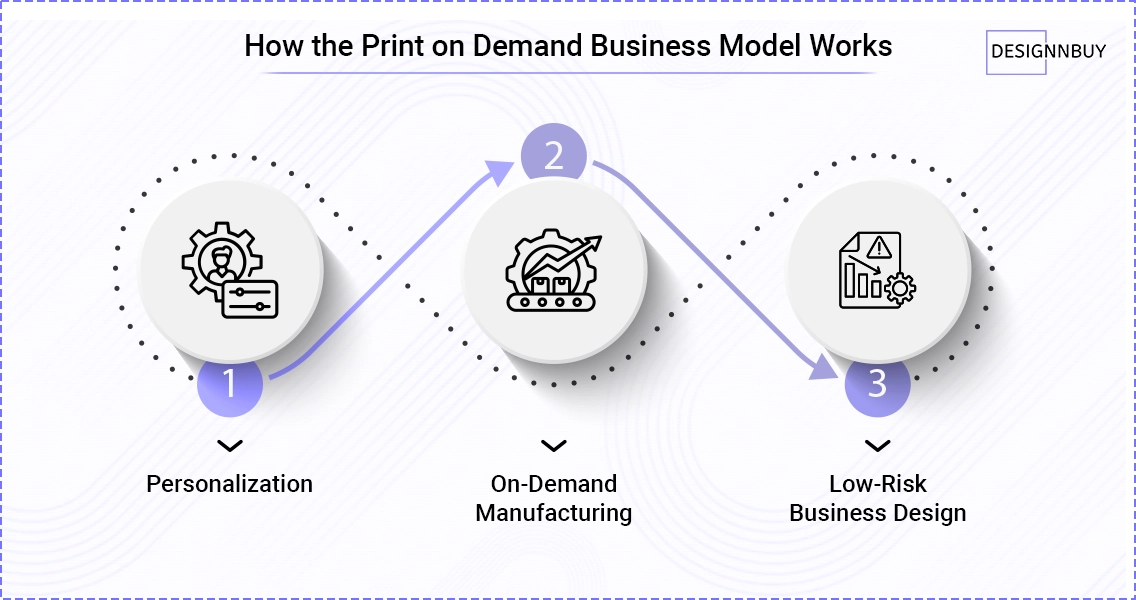
In 2026, POD is especially attractive because it aligns with three dominant market forces:
1. Personalization as a Baseline Expectation
Customers no longer see personalization as a premium feature — they expect it.
Custom names, images, messages, and layouts are becoming standard across apparel, gifting, packaging, and promotional products.
2. Sustainable, On-Demand Manufacturing
Make-to-order production directly supports sustainability goals by reducing overproduction and waste. Unlike traditional bulk manufacturing, POD ensures products are only created after a confirmed purchase, eliminating unsold inventory and excess storage requirements. When paired with automated design validation and print-ready file generation, businesses also reduce material errors, reprints, and rejected orders — making sustainability a byproduct of efficient systems, not an added cost.
3. Low-Risk Business Entry with High Upside
POD allows entrepreneurs and established businesses alike to:
Test new products quickly
Launch without inventory investment
Scale without operational complexity
However, the model only works when the technology stack is designed correctly.
If you’d like to see some popular Print On Demand businesses that are excelling in 2026, here’s a list of the best Print On Demand Businesses.
Why the Right POD Tech Stack Matters More Than Ever
One of the biggest misconceptions in POD is that “any tools will work.” Even when choosing from the best web to print softwares , success depends on how well those tools work together.
In reality, most POD businesses struggle because they rely on:
Manual file handling
Disconnected design tools
Poor fulfilment coordination
Inconsistent customer experience
This leads to:Order errors
Delayed production
Customer dissatisfaction
Scalability bottlenecks
A successful POD operation must support five core pillars seamlessly:
Product personalization
Inventory synchronization
Production & fulfilment
End-to-end customer experience
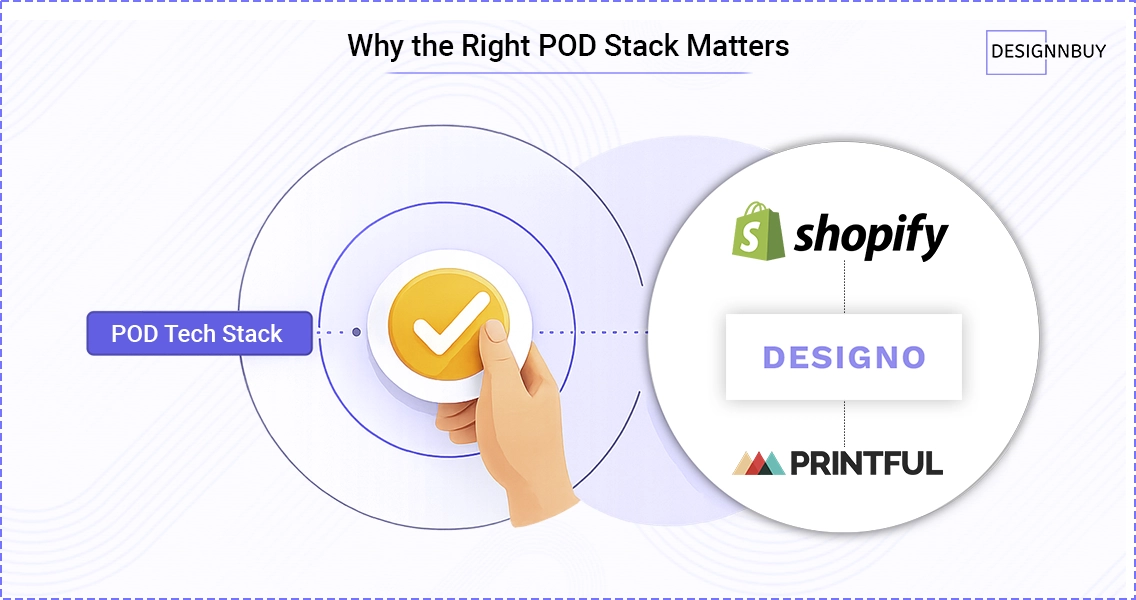
The Shopify + DesignO + Printful POD stack addresses all five natively.
Learn how to transform your Print On Demand business into a thriving web to print eCommerce empire with DesignO’s Shopify web to print tool.
Component 1: Shopify: The E-commerce Backbone
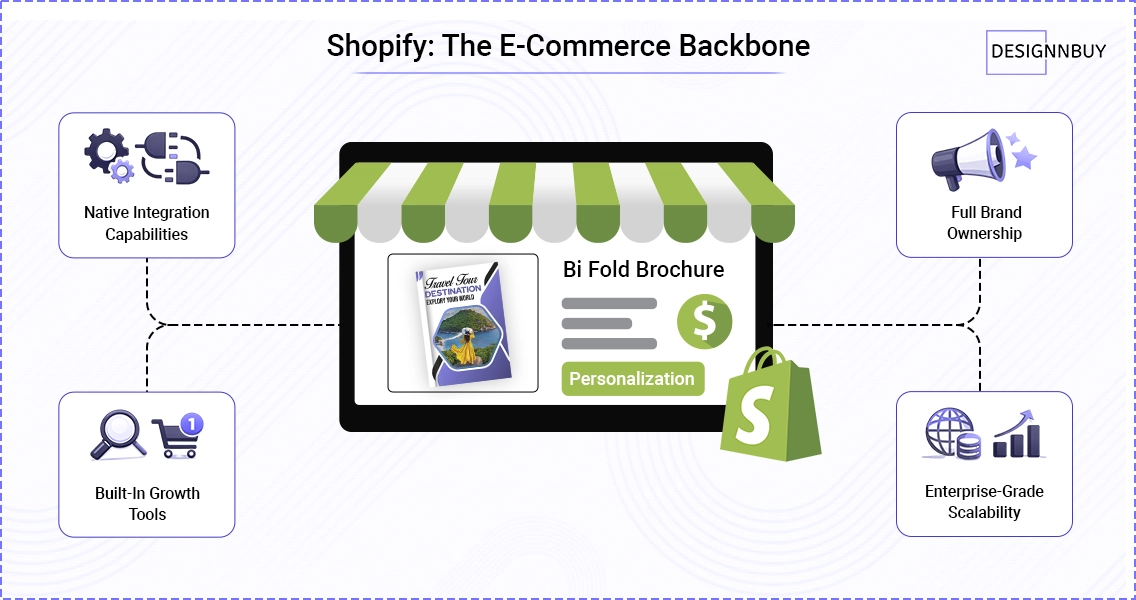
Role: Storefront, checkout, payments, marketing, scalability
Shopify has established itself as the preferred e-commerce platform for POD businesses worldwide. Its architecture is particularly well-suited for made-to-order and dropship-based workflows.
Why Shopify Works for Print On Demand in 2026
1. Native Integration Capabilities
Shopify supports:
Automated order routing
Complex product variants (size, color, style)
Custom product options
Seamless third-party integrations
2. Full Brand Ownership
Unlike marketplaces, Shopify allows:
Complete control over branding
Ownership of customer data
Long-term brand equity building
3. Built-In Growth Tools
Shopify includes:
SEO-ready site structure
Social commerce integrations
Abandoned cart recovery
Discount and promotion management
4. Enterprise-Grade Scalability
Whether you sell 10 products or 10,000, Shopify handles:
Traffic spikes
International sales
Multiple currencies
High transaction volumes
In short, Shopify provides a stable, scalable commercial foundation for POD businesses.
Component 2: DesignO: Advanced Personalization Engine
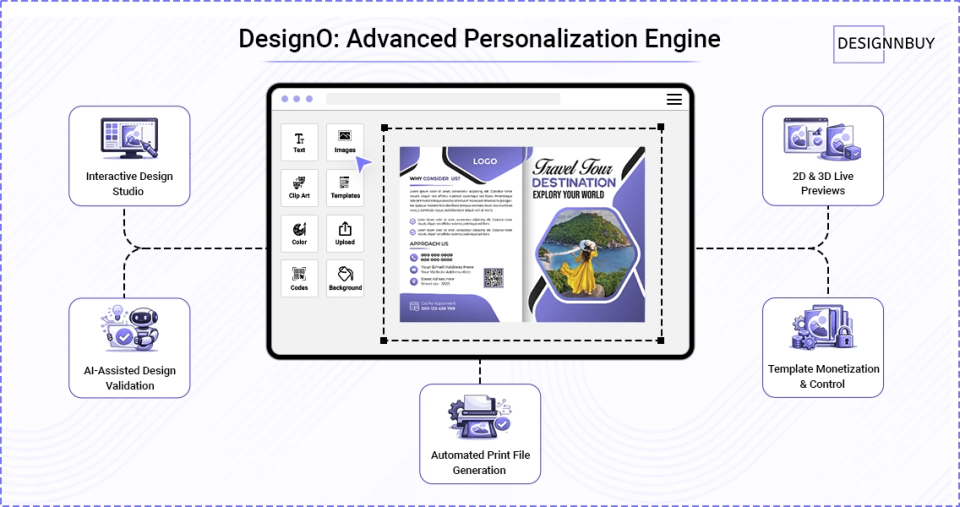
Role: Online product customization, design automation, print readiness
While Shopify handles commerce, DesignO transforms the store into an interactive design platform.
In 2026, simple “text box customizers” are no longer sufficient. Customers expect professional-grade customization experiences, and DesignO delivers exactly that.
What DesignO Brings to POD Businesses
1. Interactive Design Studio
Customers can:
Add text using hundreds of fonts
Upload images and logos
Customize layouts within defined boundaries
Preview designs in real time
2. 2D & 3D Live Previews
Giving buyers a realistic 3D preview of the final package removes uncertainty before production and improves:
Buyer confidence
Conversion rates
Design accuracy
3. AI-Assisted Design Validation
DesignO helps ensure:
Proper alignment
Print-safe layouts
Optimized color usage
Production-ready files
4. Automated Print File Generation
Every order generates:
Correct bleed and cut marks
Vector outputs for production
5. Template Monetization & Control
Businesses can:
Offer editable templates
Lock critical elements
Speed up customer decisions
Maintain brand consistency
DesignO effectively removes the biggest operational risk in POD: incorrect or unusable print files.
Component 3: Printful: Production & Fulfillment at Scale
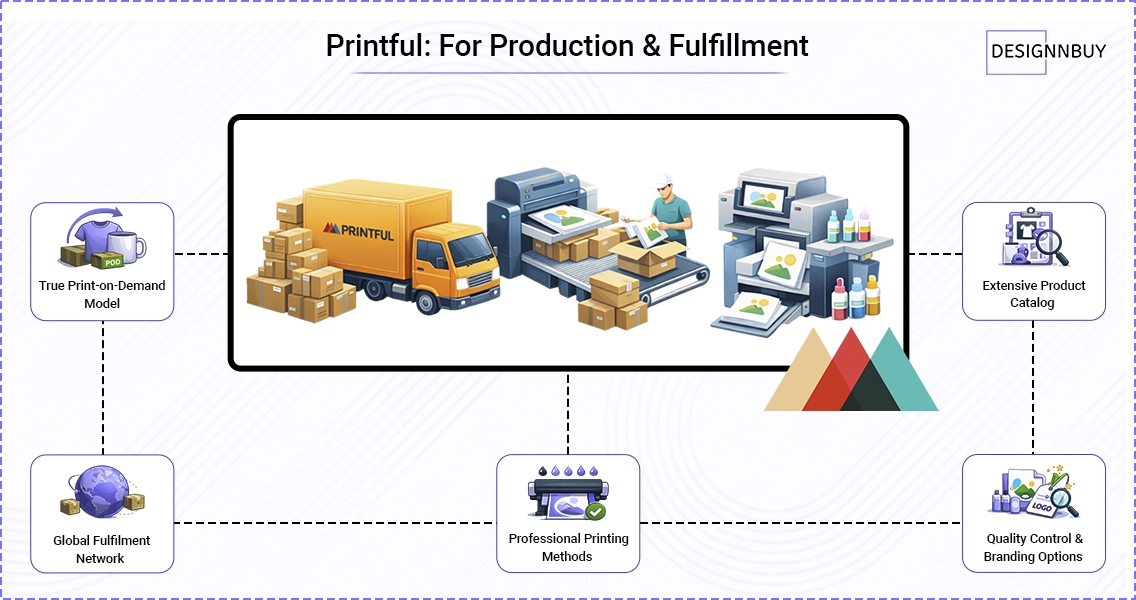
Role: Manufacturing, quality control, global shipping
Printful completes the stack by handling everything after checkout — without requiring inventory or warehouse investment.
Why Printful Remains a Top Fulfillment Choice
1. True Print-on-Demand Model
Pay only when an order is fulfilled
No setup fees
No minimum orders
No monthly costs
2. Extensive Product Catalog
Hundreds of customizable products across:
Apparel
Accessories
Home & living
Stationery
Wall décor
3. Global Fulfilment Network
Multiple production facilities worldwide ensure:
Faster delivery times
Lower shipping costs
Reduced cross-border friction
4. Professional Printing Methods
Including:
Sublimation
All-over printing
5. Quality Control & Branding Options
Each product undergoes inspection and can be shipped with:
Custom packing slips
Branded inserts
White-label packaging
Printful allows POD businesses to scale without hiring production staff or managing logistics.
How Shopify, DesignO, and Printful Work Together
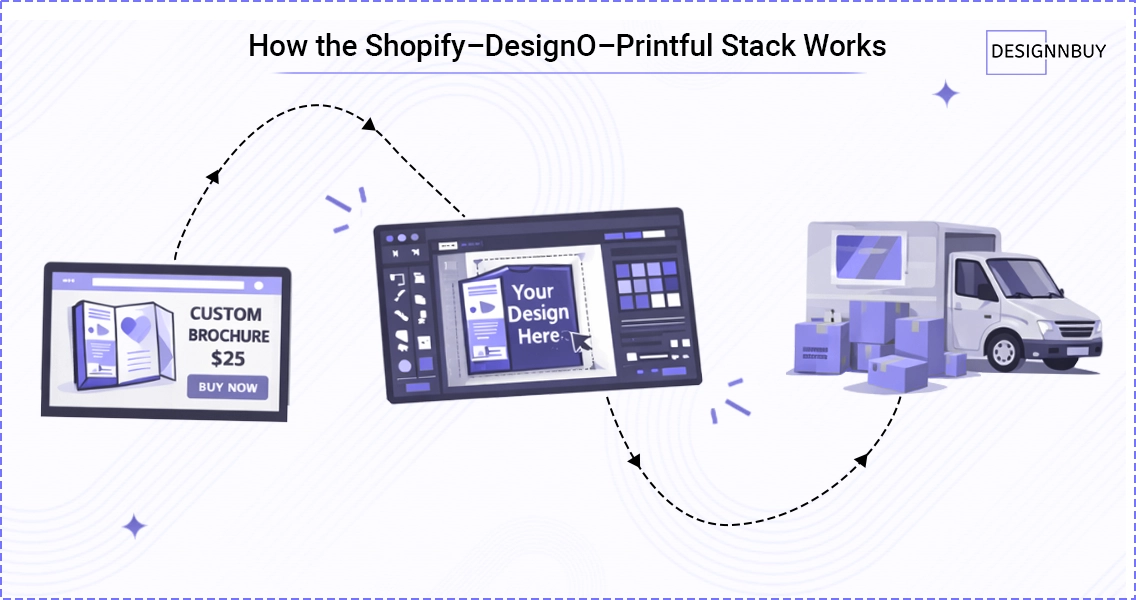
The strength of this stack lies in system-level integration.
1. End-to-End Workflow
Customer browses products on Shopify
Clicks “Customize” and designs the product using DesignO
Completes checkout via Shopify
Order and print-ready files automatically sync to Printful
Printful produces, packages, and ships the product
Tracking and order status sync back to Shopify
2. Backend Benefits for Business Owners
No manual file transfers
No order duplication
Centralized order management
Automated customer notifications
Consistent production quality
This system scales cleanly — whether you process 10 orders per week or 10,000 per month.
Final Thoughts: A 2026-Ready POD Infrastructure
The Shopify + DesignO + Printful stack is not about shortcuts.
It’s about building a future-proof POD business on reliable systems.
After 15 years in SaaS and eCommerce, I can confidently say:
Businesses don’t scale because they work harder — they scale because their systems are designed to grow.
If you’re entering print on demand in 2026 or restructuring an existing operation, this stack provides:
Stability
Automation
Scalability
Professional customer experience
The market is still growing — but expectations are rising fast.
Those who build on the right foundation will lead.
Those who don’t will struggle to keep up.
Ready to Build a Strong POD Stack?
Frequently Asked Questions-
Abhishek Agarwal
Co-founder/CMO, DesignNBuy
Abhishek Agarwal (Co-founder/CMO, DesignNBuy) has 15+ years of IT & web-to-print experience. He specializes in sales, marketing, and strategic business growth, delivering innovative solutions to global printers and mentoring teams.
All PostsRelated Posts

How Print Businesses Turn Product Mockups Into Approved Orders With Collaborative Personalization

DesignO: Build a Custom Uniform Ordering Experience for Sports, Workwear & Healthcare
What Print Businesses Should Know About Large Format Printing Products In 2026
Trusted by 2000+ Print Businesses
Ready to See It in Action?
Explore our print shop platform at your convenience. Request a demo URL to experience the storefront, design tool, pricing, and much more.